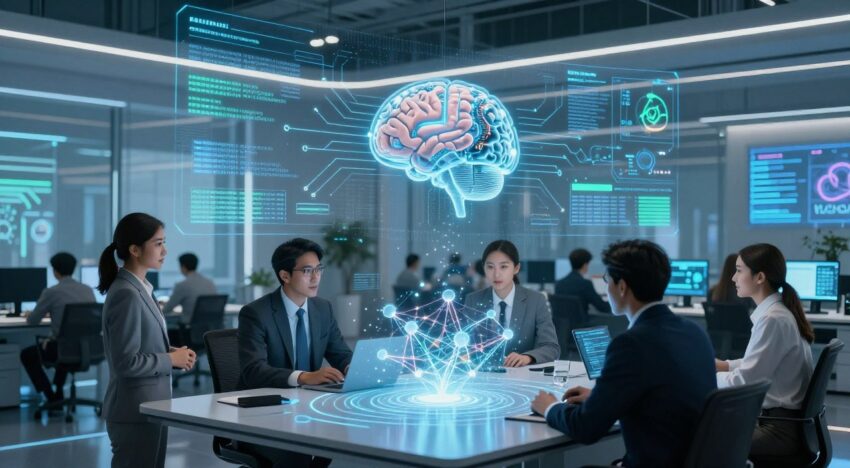
Modern software acts like a human brain to handle huge amounts of data. These basics are the artificial intelligence fundamentals for today’s tech. They let computers learn and change based on new information.
A simple ai explanation makes this complex topic easier. Computers use math to find patterns in numbers. This lets them make smart choices without needing us all the time.
Understanding ai technology is key for our digital future. These smart systems change our lives in many ways. They make work faster and more precise for people in the United States. This growth changes how we interact with the world.
Key Takeaways
- Explore the core pillars of machine logic and processing.
- Understand how software interprets large datasets for results.
- Identify the importance of neural pattern recognition in tools.
- See the connection between math and modern smart systems.
- Recognize how automation boosts global productivity levels.
- Learn why data serves as the foundation for machine learning.
Understanding Artificial Intelligence Fundamentals
Artificial intelligence is everywhere in today’s tech world. It has a long history and key traits that show how it works. Knowing the basics of AI is key to understanding its uses now and in the future.
Defining Artificial Intelligence
Artificial intelligence means making computers that can do things humans do, like seeing, talking, and making choices. These systems can act on their own, using data and rules to decide what to do.
AI covers many fields, like computer science and math. These areas help make machines that think like us.
The Evolution of AI Technology
AI has been around for decades. But, big leaps in computing and data have made it real. The evolution of AI technology has seen ups and downs, with times of fast growth and times of less interest.
Now, with machine learning and lots of data, AI is booming. It’s used in many areas, like health, money, travel, and learning.
Key Characteristics That Make Systems Intelligent
So, what makes a system smart? AI systems can learn, reason, and interact with their world. Machine learning basics teach algorithms to get better at tasks over time.
- The ability to learn and adapt, getting better with time.
- The skill to reason and solve problems, using complex methods.
- The power to understand and create human language, making it easier to talk to humans.
These traits help AI systems do many things humans used to do alone.
What Is Artificial Intelligence and How It Works
AI works by processing data, recognizing patterns, and learning from it. It’s designed to think like humans by understanding information, learning from it, and making decisions.
The Core Principles Behind AI Operations
AI systems mimic human intelligence through several key principles. They can handle big data, spot patterns, and adjust to new info through learning.
Data processing is key, as AI needs data to learn and decide. The quality and amount of data affect how well AI models work.
Data Processing and Pattern Recognition
Data processing in AI starts with input data collection and preparation.
Input Data Collection and Preparation
The first step is gathering relevant data from different sources. Then, it’s cleaned and ready for analysis. This means removing unwanted info, fixing missing data, and making it easier to understand.
Feature Extraction and Analysis
Next, feature extraction picks out important details from the data. These are then analyzed to find patterns and connections.
Training and Learning Mechanisms
AI learns in many ways, like supervised, unsupervised, and reinforcement learning.
Supervised Learning Methods
In supervised learning, AI is trained with data that has the right answers. It learns to predict the right output based on the input.
Unsupervised Learning Approaches
Unsupervised learning uses AI models on data without labels. They find patterns and connections on their own.
Reinforcement Learning Techniques
Reinforcement learning lets AI models learn by trying things and getting feedback. They interact with an environment and get rewards or penalties for their actions.
| Learning Mechanism | Description | Example |
|---|---|---|
| Supervised Learning | Trained on labeled data | Image classification |
| Unsupervised Learning | Trained on unlabeled data | Customer segmentation |
| Reinforcement Learning | Learns through trial and error | Game playing AI |
Essential AI Technologies and Algorithms
AI is built on various technologies and algorithms. These allow for the creation of intelligent systems that think like humans. They are the foundation of AI’s abilities, supporting everything from simple tasks to complex decisions.
Machine Learning Basics
Machine learning is key to AI. It trains algorithms to learn from data and make predictions or decisions without being programmed. It includes supervised, unsupervised, and reinforcement learning.
Decision Trees and Random Forests
Decision Trees are algorithms for classification and regression tasks. They split data based on input feature values. Random Forests combine multiple trees to improve accuracy and robustness.
Support Vector Machines
Support Vector Machines (SVMs) are used for classification. They find the best hyperplane to separate data into classes.
Regression and Classification Models
Regression models predict continuous outcomes. Classification models predict categorical outcomes. Both are vital in AI, with regression for forecasting and classification for spam detection.
| Model Type | Use Case | Example |
|---|---|---|
| Regression | Predicting Continuous Outcomes | Forecasting stock prices |
| Classification | Predicting Categorical Outcomes | Email spam detection |
Neural Networks Explanation
Neural networks mimic the human brain. They have layers of interconnected nodes or “neurons.” They excel in complex tasks like image and speech recognition.
Artificial Neural Network Structure
An Artificial Neural Network (ANN) has an input layer, hidden layers, and an output layer. This structure helps ANNs learn and represent complex relationships.
Deep Learning and Convolutional Networks
Deep Learning uses neural networks with many layers. Convolutional Neural Networks (CNNs) are great for image processing tasks.
Recurrent Neural Networks
Recurrent Neural Networks (RNNs) handle sequential data. They are used in language translation and speech recognition.

Cognitive Computing Overview
Cognitive computing is a new computing era. It aims to simulate human thought processes. It uses AI, machine learning, and other technologies to create systems that can reason, learn, and interact with humans.
Cognitive computing systems can handle real-world data’s ambiguity and uncertainty. They are useful in healthcare and finance.
AI Applications in Business and Beyond
AI technology is growing fast and touching many areas, like business and more. It’s not just for one field; it’s changing many by making things better, cheaper, and smarter.
AI in Healthcare and Medical Diagnostics
AI is changing healthcare by making diagnoses better and treatments more personal. Machine learning algorithms look through lots of medical data to find patterns humans might miss.
AI in medical checks is helping patients by spotting diseases early and finding the best treatments. For example, AI can look at medical pictures to find problems like tumors faster and better than doctors.
AI Applications in Business Operations
Businesses use AI to make things run smoother, serve customers better, and stay ahead. AI helps in many ways, from talking to customers to predicting what will happen next.
Customer Service and Chatbots
AI chatbots are changing customer service by being always there and quick to respond. They use natural language processing (NLP) to talk to customers in a way that feels natural.
By handling simple tasks, businesses can focus on more important work. This makes everything run more smoothly.
Predictive Analytics and Forecasting
AI helps businesses make smart choices by predicting what will happen next. It looks at past data and current trends to spot chances and challenges.
This is really helpful in industries that are hard to predict or have complex supply chains. Knowing what’s coming can really help a business stay profitable.
AI in Finance and Banking
The finance world is using AI to manage risks, catch fraud, and serve customers better. AI looks at transaction data to find signs of fraud.
AI also helps make financial services more personal. It gives advice and product suggestions based on what a customer has done before.
AI in Transportation and Autonomous Vehicles
AI is key in making self-driving cars safer and more efficient. Self-driving cars use AI to understand what’s around them and make smart decisions.
AI in cars could mean fewer accidents, smoother traffic, and more freedom for people who can’t drive.
AI in Manufacturing and Supply Chain
In making things, AI helps make production better, predict when things might break, and improve quality. AI looks at data from machines to find problems before they get big.
In supply chains, AI helps manage stock, predict demand, and make logistics smoother. This saves money and gets things delivered faster.

Conclusion
Understanding artificial intelligence (AI) is key in today’s tech world. AI has grown a lot, changing how businesses work and opening up new chances for creativity.
AI uses complex algorithms and data processing to let machines learn and decide. Technologies like machine learning and neural networks have been key in this growth.
AI is used in many areas like healthcare, finance, transportation, and manufacturing. Knowing how AI works helps us see its power to change our lives.
To really get AI, we need to look at both its technical side and its real-world uses. As AI gets better, keeping up with its updates is important for everyone.
FAQ
What is artificial intelligence and how it works in simple terms?
Artificial intelligence is a part of computer science that makes smart machines. These machines can do things that humans do. They use algorithms to understand lots of data and make choices.Systems like Google DeepMind use these methods to solve hard problems. They do this by acting like the human brain.
What are the artificial intelligence fundamentals every beginner should know?
AI basics are about machines seeing their world and acting to reach goals. They learn, reason, and correct themselves. Companies like Microsoft and NVIDIA help make this possible.
How can I gain a better understanding ai technology and its evolution?
To understand AI, look at how it changed from simple systems to complex models. This change came from better computers and more data. Now, platforms like Amazon Web Services help developers use advanced AI models.
What are machine learning basics and how do they differ from standard programming?
Machine learning is about systems learning from data, not just following code. Traditional programming is about writing instructions. Machine learning, used by Netflix, lets systems learn from data to make predictions.
Can you provide a neural networks explanation for non-technical users?
Neural networks are like the human brain. They have layers of nodes that process information. Deep learning, used by Tesla, uses many layers to understand complex data like images.
What is a cognitive computing overview in the context of modern industry?
Cognitive computing simulates human thinking in computers. It’s different from regular AI because it aims for deeper thinking. IBM Watson is an example, helping professionals understand big data.
How are ai applications in business transforming daily operations?
AI in business makes things run smoother by automating tasks and improving decisions. Tools like Salesforce Einstein predict sales trends. Brands like Mastercard use AI to catch fraud quickly.By using AI, companies can cut down on mistakes, improve supply chains, and offer better customer service. This includes using chatbots and virtual assistants.